
Read the latest FAQs here
The Palestinian Campaign for the Academic and Cultural Boycott of Israel (PACBI), mandated by the Palestinian BDS National Committee that leads the global BDS movement to develop and ensure harmony with the movement’s anti-normalization guidelines, has received many requests for a position on the film, No Other Land, both before and after the film's Oscar win. There was a simmering controversy about the film that has become even wider, now that it has won an Oscar.
PACBI recognizes the importance of engaging in this debate, but there is a strong ethical duty to do so in a way that centers the struggle to end Israel’s genocide against 2.3 million Palestinians in Gaza and massive aggression and ethnic cleansing in the West Bank’s refugee camps and Jerusalem in particular, all enabled by the colonial West, led by the US. It is also crucial to contextualize this discussion in Israel’s 76-year-old regime of settler-colonialism and apartheid against the entire Indigenous people of Palestine.
From the moment the film, No Other Land, began to screen internationally, Israel, its massive lobby groups, and its anti-Palestinian racist partners in western cultural establishments, in the US, Germany and elsewhere, have all been attacking the film and trying to suppress it because they saw it as exposing an important, if partial, dimension of Israel’s system of colonial oppression to which Palestinians are subjected to and resist in diverse ways. They see such exposures of Israel’s crimes, such as the ethnic cleansing of Masafer Yatta, as strengthening the global Palestine solidarity movement and accelerating the already fast-growing BDS movement, which Israel has for more than a decade considered a “strategic threat” to its entire regime of oppression.
However, it is important to note that Israel’s attacks on any project that happens to violate the Palestinian anti-normalization guidelines does not play a major role in deciding whether the BDS movement will launch a boycott campaign against that particular project or not. Adhering to the principles and spirit of the movement’s guidelines, our main priority is always to defend the Palestinian people’s basic rights through dismantling Israel’s settler colonial and apartheid regime. Therefore, given the BDS movement's limited resources, it has to choose its targets very carefully, based on criteria whose effectiveness has been proven over the past two decades.
But an important factor too is that Palestinians, many Arabs, and many in the solidarity movement globally, have criticized the film as a case of normalization, with some calling for a boycott of the film accordingly.
So what’s the BDS movement’s position?
First, the Palestinian Campaign for the Academic and Cultural Boycott of Israel (PACBI) has from the start reached the conclusion that this film indeed violates the BDS movement’s anti-normalization guidelines in several ways. The BDS movement has always fought against normalization as a powerful weapon employed by oppressors to whitewash their crimes, to colonize the minds of the oppressed, and to undermine global solidarity with the struggle to end oppression.
Regardless of intentions, and according to the anti-normalization guidelines agreed upon by the vast majority of Palestinian civil society, normalization is the participation in any project, initiative or activity, local or international, that brings together (on the same “platform”) Palestinians (and/or Arabs) and Israelis (individuals or institutions) and does not meet the following two conditions:
The Israeli side must publicly recognize the UN-affirmed inalienable rights of the Palestinian people (at the very least an end to the occupation, end to apartheid, and the right of return for Palestinian refugees); and
The joint activity must constitute a form of co-resistance against the Israeli regime of occupation, settler-colonialism, and apartheid.
No Other Land was produced with the help of Close-Up, an organization that is engaged in normalization and is therefore boycotted by many filmmakers and PACBI. Moreover, some of the team’s Israeli members are not on record supporting the comprehensive rights of the Palestinian people. They have failed to acknowledge that Israel is perpetrating a genocide, or have even made extremely harmful, immoral statements drawing a false equivalence between the colonizer and the colonized that may be used to rationalize Israel’s genocide. Accordingly, the film certainly violates the BDS movement’s anti-normalization guidelines.
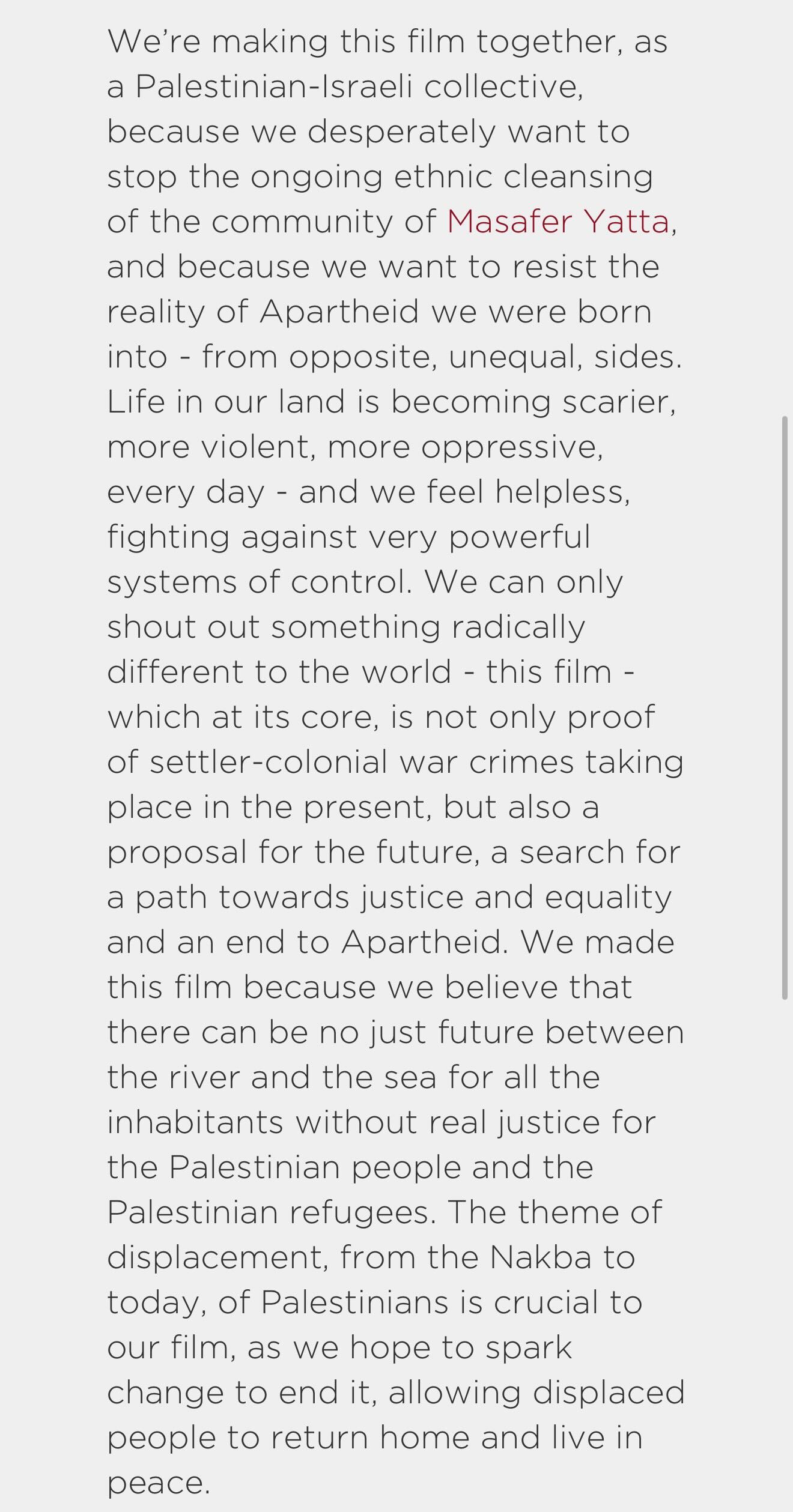
We acknowledge that the film’s team recently published a statement that explicitly mentions the Nakba, ethnic cleansing, settler-colonialism, and apartheid. Calling for justice for Palestinian refugees, it goes a long way to address the above-mentioned serious flaws. Yet, the statement still fails to identify Israel as the perpetrator of all these crimes*.
Second, regardless of the above and aside from BDS guidelines, it is important to recognize that Palestinians do not need validation, legitimation or permission from Israelis to narrate our history, our present, our experiences, our dreams, and our resistance, including artistic resistance, to the colonial system of oppression that denies us our freedom and inalienable rights. It is therefore imperative for us to challenge the racist conditions, whether covert or overt, imposed by the colonial West and its hegemonic institutions, which do not platform Palestinians except with the permission or validation of Israelis.
But why is PACBI only now publicly issuing this position?
PACBI has not published its position, but has shared it with many filmmakers and festival organizers who have inquired over the last year.
While PACBI understands the debate around the film as an indicator of the growth of the popular resistance to normalization, which we appreciate, it strives to enact “strategic radicalism,” prioritizing the most complicit targets where we can achieve the most impact, guided by our principles and our overarching goal of ending international complicity in Israel’s oppression and advancing the struggle for Palestinian liberation. PACBI therefore does not, and realistically has no capacity to, publish a statement on every instance of normalization.
Over the last 17 months of the US-Israeli genocide in Gaza, the entire BDS movement, including PACBI and all its partners and networks, has been intensively leading, devising and supporting many strategic campaigns to cut the chains of international complicity with Israel’s genocide and underlying regime of settler-colonial apartheid. A crucial part of this work has always been fighting the dehumanizing colonial narratives and stereotypes propagated by Israel and its anti-Palestinian racist partners.
Given the many urgent cultural boycott projects worldwide that PACBI had to lead or support during this ongoing genocide, No Other Land was not a priority prior to the Oscars. Now, given its growing profile and in particular following its Oscar win, we find it important to explain how the film is in violation of BDS guidelines for people to enhance the collective understanding of normalization and its dangers, and to protect our struggle from the heightened risk of using normalization to whitewash genocide. The ends never justify the unethical means.
Hollywood has for decades dehumanized Palestinians, Arabs, Muslims, Indigenous people, as well as Black and other racialized communities. Dozens of Palestinian filmmakers recently said in an open letter that they are “outraged at the inhumanity and racism shown by some in the Western entertainment industry towards our people, even during this most difficult of times.” This dehumanization is one of the factors enabling Israel’s genocide. It is therefore not surprising that as problematic as this film is, many have overlooked its normalization problem and celebrated it for having contributed to challenging this dehumanization.
Finally, our principled, incremental struggle for liberation will depend on thousands of collective, principled and strategic efforts coming together on many fronts. In this struggle, being ethical and principled means that we should never compromise on our people’s rights. Being strategic entails prioritizing our targets to maximize the benefit to our struggle to achieve those rights. Indigenous Palestinians have no other land than Palestine. But we surely must have another way in our struggle for liberation and self-determination that is free of the less visible chains of normalization.
* Following the publication of this statement, the No Other Land directors’ statement was updated to name Israel as the perpetrator, and to mention Israel’s genocide in Gaza. We reproduce a screenshot of the previous version below.